THE 2026 ALTIUS CONFERENCE AT OXFORD
11–13 DECEMBER 2026 · OXFORD

AT A GLANCE
THE 2026 GATHERING
WHERE
Oxford Union, Oxford, United Kingdom
WHEN
Friday 11 – Sunday 13 December 2026
SCALE
Approximately 100 invited participants
FORMAT
Keynotes · Moderated Dialogues · Debates · Roundtables
RULE
Chatham House Rule
BEYOND THE FAMILIAR AI AGENDA
I
The conversation begins where the usual AI conversation ends.
Most AI conferences examine the next system.
Altius examines the civilization that follows.
Most AI gatherings understandably focus on the next model, the next product, the next regulatory response or the next investment cycle. Those questions matter. They are not sufficient.
Altius asks what follows when intelligent machines cease to be exceptional tools and become part of the architecture of science, economies, institutions and everyday life. How must society reorganize? How can humanity retain meaningful control? What new form of collective intelligence may emerge when human and artificial cognition become increasingly interdependent?
These are not only philosophical questions. They concern how companies are led, how citizens earn and participate, what democracy means, how states compete and cooperate, and which safeguards cannot wait. They define the environment in which every shorter-term question about artificial intelligence will eventually be answered.
Those conversations are necessary.
This one begins after them.
THE PROPOSITION
II
A CIVILIZATIONAL QUESTION, NOT A TECHNOLOGY CONFERENCE.
What follows the final invention?
The title is intended as a question, not a celebration of technological inevitability. If artificial intelligence becomes humanity’s most consequential creation, what exactly are we creating — and what kind of civilization may emerge around it?
Humanity’s Magnum Opus considers increasingly capable intelligent machines not merely as a technological development, but as a possible civilizational one. The question is no longer only what these systems can do, but what forms of knowledge, agency, power, prosperity and human purpose become possible when intelligence is no longer uniquely human.
The “final invention” need not mean the end of invention.
It asks whether humanity may create the last invention whose principal inventor is human.
By “the world beyond”, we mean the civilization that follows the arrival of thinking machines: the institutions, ownership structures, forms of authority, systems of knowledge and conceptions of human purpose that must be reconsidered once non-human intelligence becomes ordinary infrastructure.
The world beyond is not a distant future.
It begins when intelligence becomes infrastructure.
A DECADE IN THE MAKING
2016 → 2026
Returning to the question after the future arrived.
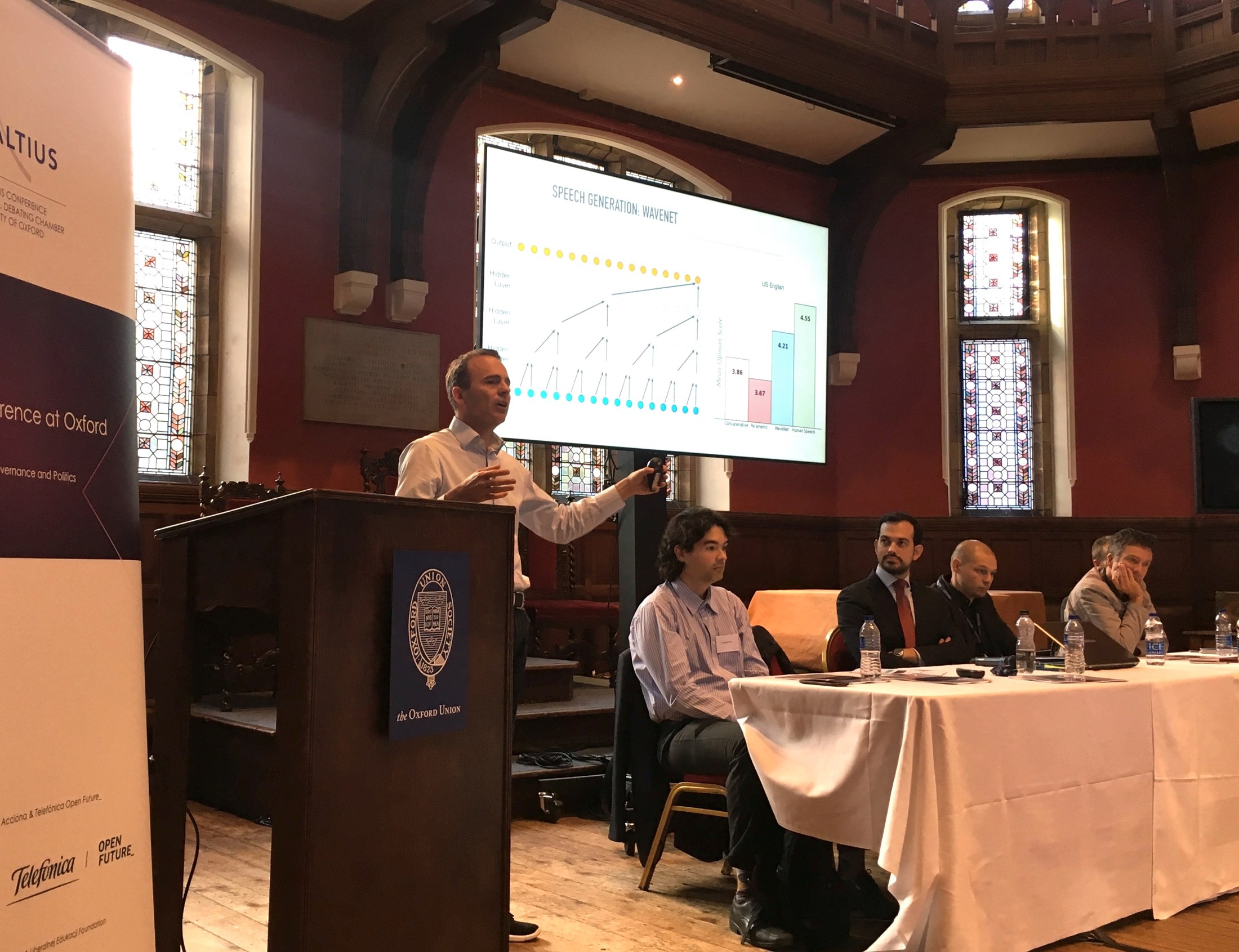
SHANE LEGG PRESENTING WAVENET · OXFORD · 2016
In autumn 2016, before large language models and generative AI entered public life, The Altius Society convened The Brain of the Future: Artificial Intelligence, Robotics, Governance and Politics in the Age of Thinking Machines at the Oxford Union.
The inquiry began with the scientific frontier — learning to learn, cognition, consciousness and the path from narrow to broader intelligence — but deliberately moved beyond technology. It examined the political economy of automation, inequality and the social contract; existential risk and global security; governance and international power; the future of cities; and, ultimately, the place of the human species in a world of increasingly capable machines.
A decade later, Altius returns not because those questions have disappeared or changed beyond recognition, but because many have moved from anticipation toward lived reality.
OXFORD · 2016
Will human intuition — including mathematical intuition — ever be achieved by a machine?
Can machines enjoy freedom? And if so, could they ever possess rights?
Is human rationality the ultimate level of rationality?
What is left for humans in a world dominated by AI?
Will values and beliefs emerge in artificial machines?
In 2026, these are no longer merely questions about machines.
They are questions about humanity.
CONTROL · COLLECTIVE · HUMAN
THE CONTROL QUESTION
THRESHOLD I
Can humanity remain the author of its future?
Meaningful human control is not simply an emergency switch or a narrow technical-alignment problem. It concerns who defines objectives, who can inspect and contest decisions, who can interrupt or redirect systems, who bears responsibility for their actions, and which values prevail when legitimate human purposes conflict.
As intelligent systems become more capable, autonomous and embedded in critical infrastructure, control may have to move from individual commands to institutional architecture: technical safeguards, ownership structures, auditable authority, democratic legitimacy and forms of international coordination capable of preserving human agency.
Meaningful control is not a button.
It is an architecture.
Who sets the ends?
Who can inspect and contest?
Who can interrupt and redirect?
Who bears responsibility?
HUMAN + ARTIFICIAL INTELLIGENCE
THRESHOLD II
Human and artificial intelligence may not remain separate domains. Science, government, firms and culture may increasingly operate through hybrid systems in which humans establish purposes, machines generate possibilities, institutions validate claims and networks coordinate action.
The result could be an extraordinary amplification of collective problem-solving — or a gradual relocation of judgment, responsibility and authorship away from human beings.
The decisive comparison may therefore not be human intelligence versus machine intelligence, but the quality of the systems formed between them.
Does integration enlarge human agency — or quietly relocate it?
Can hybrid intelligence preserve dissent, plurality and accountability?
What institutions could make coexistence cooperative rather than merely efficient?
THE PHILOSOPHICAL WAGER
THRESHOLD III
Reason, language, creativity, judgment and the capacity to construct meaning have long helped human beings explain what is distinctive about themselves. Advanced artificial intelligence unsettles that boundary.
The deepest question is therefore not simply whether machines can reproduce human capabilities. It is whether our concepts of agency, responsibility, freedom, consciousness and value remain adequate when non-human systems begin to participate in domains once treated as distinctly human.
Capability does not imply consciousness. Autonomy does not necessarily imply freedom. Intelligence alone does not establish moral status. Yet increasingly capable artificial agents may force societies to decide what evidence, principles and institutions should govern those distinctions.
What counts as a mind?
What grounds moral status?
If intelligence can be externalized, replicated and scaled, on what basis do human beings understand their own dignity and purpose?
THE 2026 CONVERSATION
FROM FIRST PRINCIPLES TO PRACTICAL CHOICES
Six Lines of Inquiry
The questions are philosophical. Their consequences are immediate.
The six chapters below ask what they mean for decisions already facing scientists, business leaders and governments.
01 — CAPABILITY, AGENCY & THE SCIENTIFIC FRONTIER
What can advanced AI actually do, what remains beyond it, and how quickly may that change?
Public debate often collapses very different systems and capabilities into a single idea of “AI”. The distinctions matter. A system may be fluent without understanding, useful without being reliable, and autonomous in one domain while brittle in another.
We will examine where the frontier is actually moving: reasoning, agency, robotics, scientific discovery and the capacity to act across increasingly complex environments. Which limits are fundamental, which are temporary, and which technical choices made now will shape what comes next?
02 — CONTROL, SAFETY & URGENT ACTION
What must governments, companies and scientists do now—before increasingly capable systems become too embedded to govern?
Technical alignment is indispensable, but control also depends on institutions, incentives and clear authority. Which capabilities require independent testing? Who can delay or stop deployment? What must be auditable, reported or internationally monitored? How do we keep critical infrastructure resilient if systems fail, are misused or behave in unexpected ways?
The central issue is not whether every risk can be eliminated. It is which safeguards, resilience measures and forms of coordination are urgent enough to establish before certainty is possible—and before a crisis makes the choices for us.
What must be done now—not after a crisis—to reduce catastrophic risk and preserve human freedom?
03 — ORGANIZATIONS & HUMAN–AI COLLECTIVE INTELLIGENCE
What happens to companies and institutions when human judgment and machine reasoning become inseparable?
For business leaders, AI may become more than another productivity tool. It may change what a company is: how many people it needs, how quickly expertise scales, how products are built, how decisions are made and where competitive advantage resides.
Which decisions should leaders delegate? What must remain contestable and accountable to humans? Can hybrid organizations become more inventive and capable without becoming opaque, dependent or impossible to govern? What remains scarce—and strategically valuable—when intelligence itself becomes scalable?
Which decisions should leaders delegate?
Where does competitive advantage reside when intelligence becomes scalable?

THE SOCIETY IN SESSION · OXFORD
04 — DEMOCRACY, TRUTH & POLITICAL LEGITIMACY
What does democracy mean when machines shape what citizens see, believe and decide?
Democracy depends on citizens being able to form judgments, know who is exercising power, contest decisions and remove those responsible. AI could strengthen public services and collective reasoning. It could also personalize persuasion at scale, flood the public sphere with synthetic content and move consequential decisions into systems no voter elected and few officials fully understand.
How should democratic governments use AI without weakening accountability? Who is answerable when automated systems influence benefits, policing, elections, regulation or war? Can political institutions remain legitimate when the machinery of decision becomes increasingly opaque?
Can a decision remain democratic if no accountable human being fully understands how it was made?
05 — WORK, OWNERSHIP & MONEY
What happens to employment, income and money when human labour becomes less central to economic value?
Employment is not only a way to earn. It structures status, routine, bargaining power, taxation and participation in society. If machines perform a growing share of cognitive and physical work, the consequences will reach far beyond individual jobs.
Who owns the systems that produce value? How should the gains be distributed? What becomes of wages, careers, taxation and the financing of the state? In a world of abundance in some domains and persistent scarcity in others, does money retain the same role—and what social contract could command legitimacy?
What is employment for if it is no longer economically necessary for everyone?
Who receives the value created by productive intelligence?
Does money retain the same role in a radically more abundant economy?
06 — NATIONS, POWER & GLOBAL GOVERNANCE
Can countries compete for AI power and still cooperate to keep it under meaningful control?
Advanced AI will be developed largely by companies, but its consequences will be geopolitical. It can shift economic power, military advantage, cyber capability and dependence on chips, energy, data and infrastructure. What does sovereignty mean when critical intelligence is supplied by firms operating across borders—and when states may see restraint as dangerous if competitors continue to accelerate?
How will democracies and authoritarian systems interact in this new era? Which rules must be national, and which can work only if they are international? Are institutions designed for a twentieth-century world capable of governing intelligence that crosses borders and concentrates power—or does the global political order need to change fundamentally?
How do we prevent competition from becoming a race no country can safely leave?
Who acts when a system threatens more than one country?
Does the global political order need to change fundamentally?
THE WORLD BEYOND
Greater intelligence and greater abundance will not by themselves produce a good society. A civilization can become more capable while becoming less free, less equal or less human.
The final question is not only what can be built, but what should be built, who gets to decide, and whether human beings remain capable of choosing their own ends.
The world beyond will be shaped as much by institutions as by intelligence.
THE ALTIUS FORMAT
WHY THIS ROOM
A debate, not a broadcast.
SCIENCE · BUSINESS · GOVERNMENT · PHILOSOPHY
Those working at the frontier are not short of forecasts, demonstrations, product launches or panels. What is scarce is sustained argument across science, business, government and philosophy—and the willingness to ask what decisions follow.
The programme is built around keynotes, moderated dialogues, debates and roundtables. Keynotes establish propositions. Dialogues expose assumptions. Debates force disciplines to confront one another. Roundtables translate the argument into decisions: what governments, companies and scientific institutions should do now.
Participants are not invited simply to repeat a standard keynote. They are invited to test ideas in a room small enough for disagreement, revision and intellectual risk.
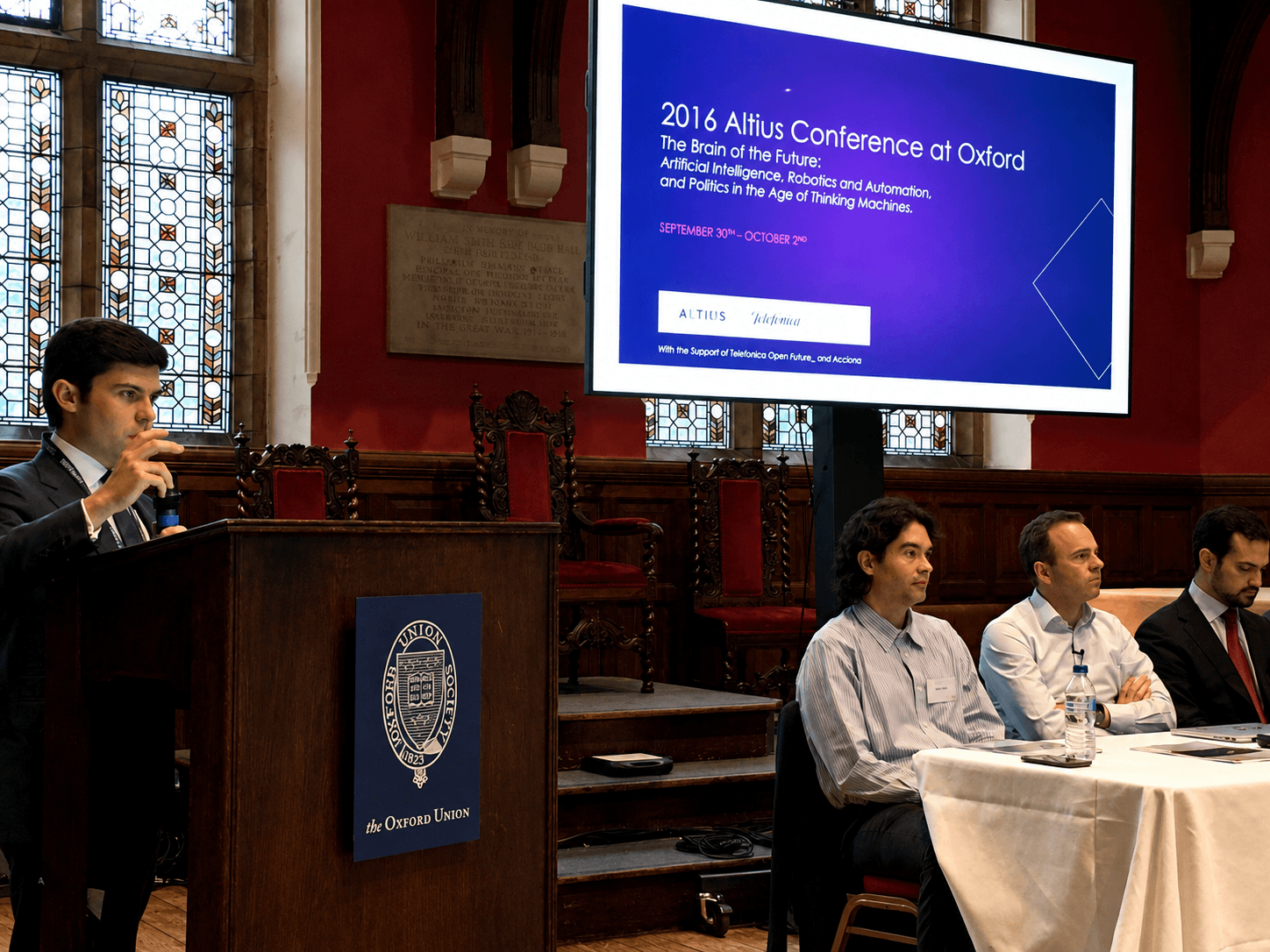
THE BRAIN OF THE FUTURE · OXFORD UNION · 2016
The value is not simply access to a stage.
SCALE
APPROXIMATELY 100 INVITED PARTICIPANTS
FORMAT
KEYNOTES · MODERATED DIALOGUES · DEBATES · ROUNDTABLES
RULE
CHATHAM HOUSE RULE
Any recording or public dissemination is by prior agreement.
